


Why Continuous Patient Monitoring Is Critical for Early Detection and Prevention

In today’s rapidly evolving healthcare landscape, the focus is shifting from reactive treatment to proactive care. One of the most significant advancements enabling this transformation is continuous patient monitoring. Unlike traditional methods that rely on periodic vital checks, continuous monitoring provides real-time, uninterrupted health data, allowing healthcare providers to detect abnormalities early and prevent complications before they escalate.
This shift is not just a technological upgrade—it is a life-saving approach that is redefining patient care across hospitals, clinics, and even homes.
What Is Continuous Patient Monitoring?
Continuous patient monitoring involves the ongoing measurement of vital signs such as heart rate, respiratory rate, oxygen saturation, and blood pressure using advanced medical devices and sensors.
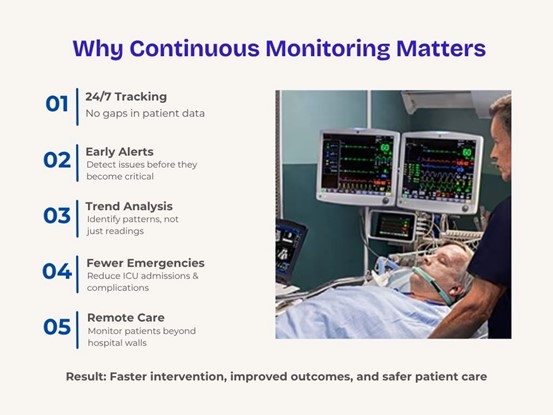
Unlike intermittent monitoring—where vitals are recorded every few hours—continuous systems:
- Track patient data 24/7
- Detect even minor fluctuations
- Provide instant alerts to healthcare professionals
This constant stream of data creates a complete picture of a patient’s health, rather than isolated snapshots.
The Need for Continuous Monitoring in Modern Healthcare
Traditional monitoring methods often leave critical gaps in patient data. In many hospital wards, vital signs are checked every 4–8 hours, which means early signs of deterioration can go unnoticed.
Continuous monitoring bridges this gap by ensuring that no critical change goes unnoticed.
How Continuous Monitoring Enables Early Detection
1. Real-Time Identification of Health Deterioration
Continuous monitoring systems track vital signs in real time, enabling healthcare providers to identify abnormalities instantly. This allows intervention hours before a condition becomes critical.
2. Detection of Subtle Trends and Patterns
Health deterioration is rarely sudden—it often begins with small, gradual changes.
Continuous monitoring:
- Tracks trends over time
- Identifies patterns in vital signs
- Predicts potential complications before symptoms appear
This predictive capability is crucial in preventing conditions like:
- Sepsis
- Cardiac arrest
- Respiratory failure
3. Faster Clinical Decision-Making
With real-time alerts and data insights, healthcare providers can:
- Make quicker decisions
- Adjust treatments instantly
- Escalate care when necessary
This reduces response time and significantly improves patient outcomes.
The Role of Continuous Monitoring in Prevention
1. Preventing Medical Emergencies
Early detection allows healthcare teams to intervene before a condition worsens, reducing the risk of:
- ICU admissions
- Emergency interventions
- Life-threatening complications
2. Reducing Hospital Readmissions
For patients with chronic conditions such as:
- Diabetes
- Hypertension
- Heart disease
Continuous monitoring helps maintain stable health by identifying warning signs early, leading to fewer hospital visits and readmissions.
3. Supporting Post-Discharge Care
After discharge, patients are still vulnerable. Continuous monitoring ensures:
- Safe recovery at home
- Early identification of complications
- Reduced burden on hospital resources
Benefits for Healthcare Providers
Improved Patient Safety
Continuous monitoring enhances patient safety by ensuring that critical changes are detected immediately, reducing the chances of missed deterioration.
Better Resource Utilization
Hospitals can:
- Prioritize high-risk patients
- Reduce unnecessary ICU admissions
- Optimize staff workload
This leads to more efficient healthcare delivery.
Data-Driven Care
Continuous monitoring provides:
- Real-time data
- Historical trends
- Actionable insights
This supports evidence-based decision-making and personalized treatment plans.
Benefits for Patients
Enhanced Peace of Mind
Patients feel more secure knowing their health is being monitored continuously, even outside hospital settings.
Improved Quality of Life
Remote and contactless monitoring allows patients to:
- Recover comfortably at home
- Avoid frequent hospital visits
- Maintain independence
Early Intervention, Better Outcomes
The earlier a condition is detected, the better the chances of recovery. Continuous monitoring ensures timely care, reducing complications and improving survival rates.
The Future of Continuous Patient Monitoring
With advancements in:
- Artificial Intelligence (AI)
- Internet of Things (IoT)
- Contactless monitoring technologies
Continuous patient monitoring is becoming more:
- Accurate
- Accessible
- Predictive
Modern systems can even forecast potential health risks using data analytics, enabling truly preventive healthcare.
Conclusion
Continuous patient monitoring is no longer a luxury—it is a necessity in modern healthcare. By enabling real-time tracking, early detection, and timely intervention, it plays a critical role in preventing complications and saving lives.
For healthcare providers, it means better efficiency and improved outcomes. For patients, it ensures safer, more personalized care.
As healthcare continues to evolve, continuous monitoring will remain at the forefront of a system that prioritizes prevention over cure—making healthcare smarter, faster, and more effective.