


From Hospital to Home: The Rise of At-Home Patient Monitoring Devices

The healthcare industry is undergoing a major transformation. Traditionally, patient care was limited to hospitals and clinics, where monitoring depended on periodic visits and manual observations. Today, with the rapid advancement of digital health technologies, care is no longer confined within hospital walls. At-home patient monitoring devices are redefining how healthcare is delivered—making it more continuous, personalized, and accessible than ever before.
Understanding At-Home Patient Monitoring
At-home patient monitoring, also known as Remote Patient Monitoring (RPM), involves the use of connected medical devices that track a patient’s health data outside clinical settings. These devices collect vital health parameters and transmit them to healthcare providers in real time, enabling continuous supervision without requiring hospital stays.
Common devices used in home monitoring include:
- Blood pressure monitors
- Pulse oximeters
- Glucometers
- Smart wearables (heart rate, activity tracking)
- Digital thermometers
- Contactless monitoring systems (sleep & respiration tracking)

Why the Shift from Hospital to Home?
1. Rising Chronic Diseases
The global increase in chronic conditions like diabetes, hypertension, and heart disease has created a need for continuous monitoring rather than occasional check-ups.
2. Aging Population
Home monitoring enables seniors to maintain independence while staying medically supervised.
3. Post-Pandemic Healthcare Evolution
The pandemic accelerated the adoption of remote healthcare, reducing unnecessary hospital visits.
4. Technological Advancements
AI, IoT, and wearable technology have made monitoring devices more accurate and accessible.
How It Works
At-home patient monitoring systems follow a simple process:
- Data Collection through smart devices
- Data Transmission via apps or cloud
- Data Analysis by AI or healthcare providers
- Timely Medical Intervention
Use Cases of At-Home Monitoring
1. Chronic Disease Management
Continuous tracking for diabetes, hypertension, and heart conditions.
2. Post-Surgical Recovery
Reduces hospital stays while ensuring safe recovery.
3. Elderly Care
Ensures safety for seniors living independently.
4. Maternal and Newborn Care
Monitors vital health indicators without frequent visits.
5. Sleep and Respiratory Monitoring
Tracks breathing patterns and sleep quality.
The Role of Smart Technologies
Modern devices are powered by:
- Artificial Intelligence (AI)
- Internet of Medical Things (IoMT)
- Cloud Computing
- Wearable Technology
These technologies enable predictive and proactive healthcare.
Challenges to Consider
- Data privacy and security concerns
- Difficulty in adoption for elderly users
- Dependence on internet connectivity
- Need for clinical validation
The Future of Healthcare: A Hybrid Model
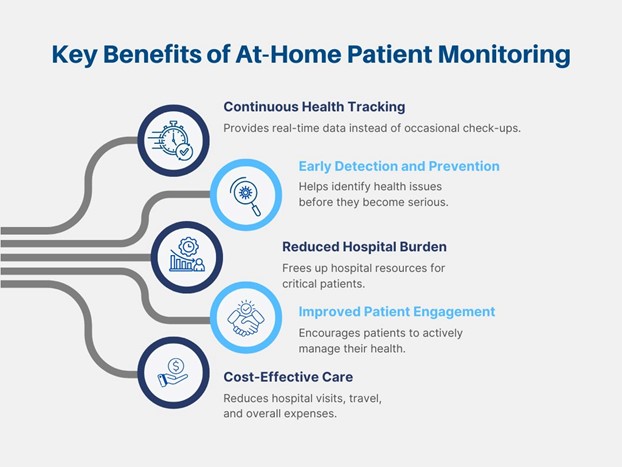
The future lies in combining hospital care with home-based monitoring. Hospitals will handle critical cases, while routine monitoring shifts to homes—creating a more efficient healthcare system.
Conclusion
The rise of at-home patient monitoring devices marks a major shift toward patient-centric healthcare. By bringing care into homes, these technologies improve accessibility, reduce costs, and enable early intervention.
For Alpha Health, this evolution is an opportunity to deliver innovative solutions that enhance patient outcomes beyond hospital boundaries. The future of healthcare is no longer just in hospitals—it’s right at home.