

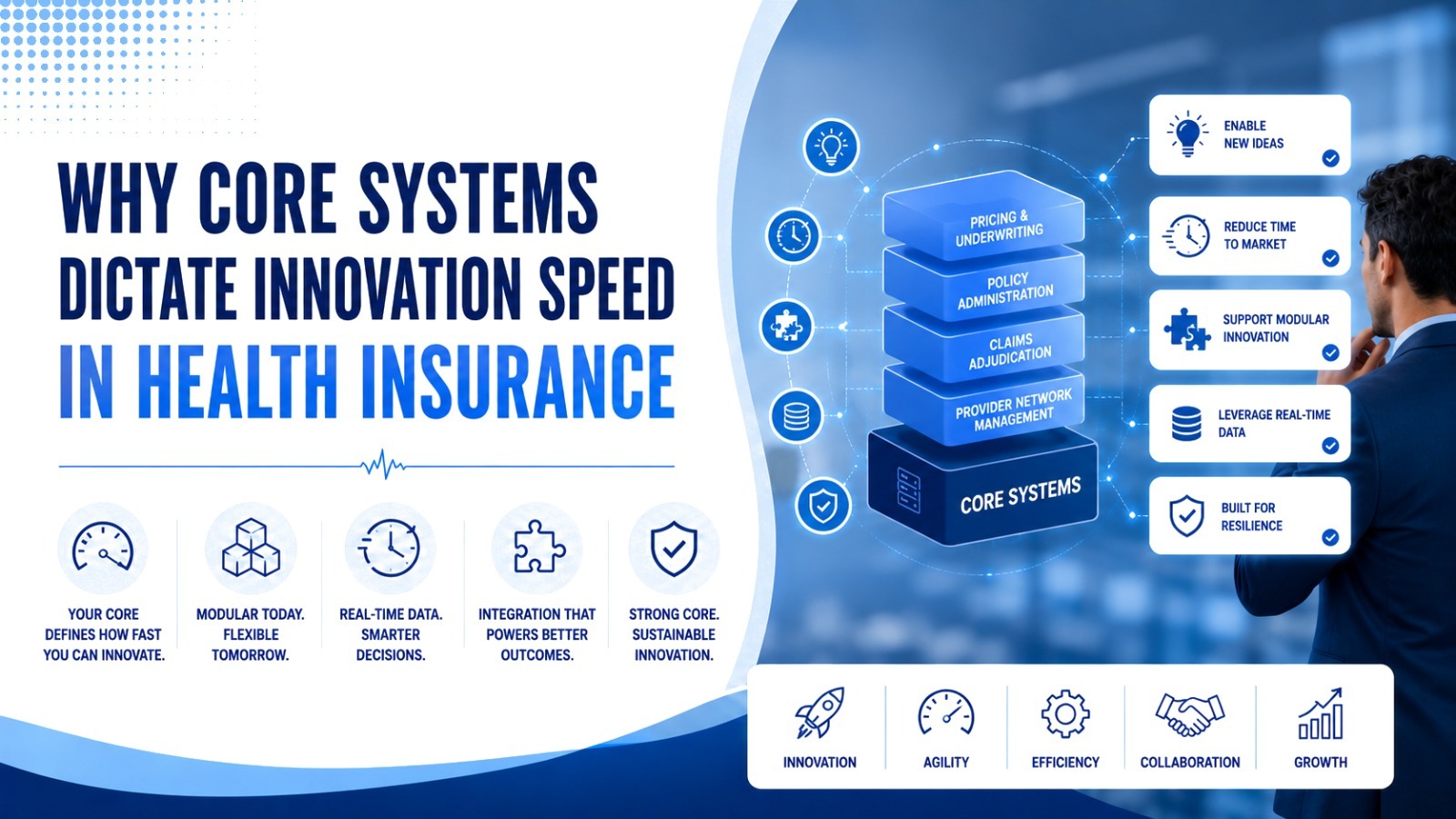
Why Core Systems Dictate Innovation Speed in Health Insurance

Innovation in health insurance is often discussed in terms of customer experience, digital apps, AI, or new care models. But in practice, the pace at which an insurer can innovate is rarely determined by its front-end ideas. It is dictated—quietly and decisively—by its core systems.
Put simply: your core architecture defines what is possible.
The Hidden Constraint
Most insurers believe innovation happens at the edges—launching a new product, digitizing claims, partnering with providers, or experimenting with value-based care.
But innovation is not constrained at the edges.
It is constrained upstream.
If your core systems cannot:
- Price a product dynamically
- Adjust benefits without manual intervention
- Integrate real-time data from providers or devices
- Support modular product design
…then even the best ideas never leave the boardroom.
They stall—not because they are bad ideas—but because the system cannot support them without disproportionate effort, cost, or risk.
Core Systems: The Real Operating Model
In health insurance, the “core” is not just IT infrastructure. It is the operating model embedded in technology:
- Policy administration
- Claims adjudication
- Provider network management
- Pricing and underwriting logic
These systems encode:
- How products are structured?
- How rules are applied?
- How decisions are made?
Over time, they become a reflection of past assumptions:
- Static benefit design
- Annual plan cycles
- Manual approvals
- Siloed data
When the market changes—but the system does not—the organization’s ability to respond becomes constrained.
What High-Velocity Innovators Do Differently
Organizations that innovate faster share one common trait:
They treat core architecture as a strategic asset, not a technical necessity.
Practically, this means:
- Modular Design Over Monoliths
- Configurability Over Customization
- Real-Time Data as Standard
- API-First Integration
- Reduces dependencies and accelerates collaboration
The Strategic Choice
Insurers today face a structural choice:
Option 1: Continue Layering Innovation on Legacy
- Short-term wins
- Increasing complexity
- Declining agility
Option 2: Re-architect for Flexibility
- Higher upfront investment
- Stronger long-term capability
- Sustainable innovation speed
There is no neutral ground.
My Perspective
Insurers today face a structural choice:
Option 1: Continue Layering Innovation on Legacy
- Short-term wins, Increasing complexity, Declining agility
Option 2: Re-architect for Flexibility
- Higher upfront investment, Stronger long-term capability, Sustainable innovation speed
There is no neutral ground.
In reality, it is a question of architecture.
Because ultimately:
You do not innovate as fast as your strategy allows.
You innovate as fast as your core systems permit.
Let me know what you think…