

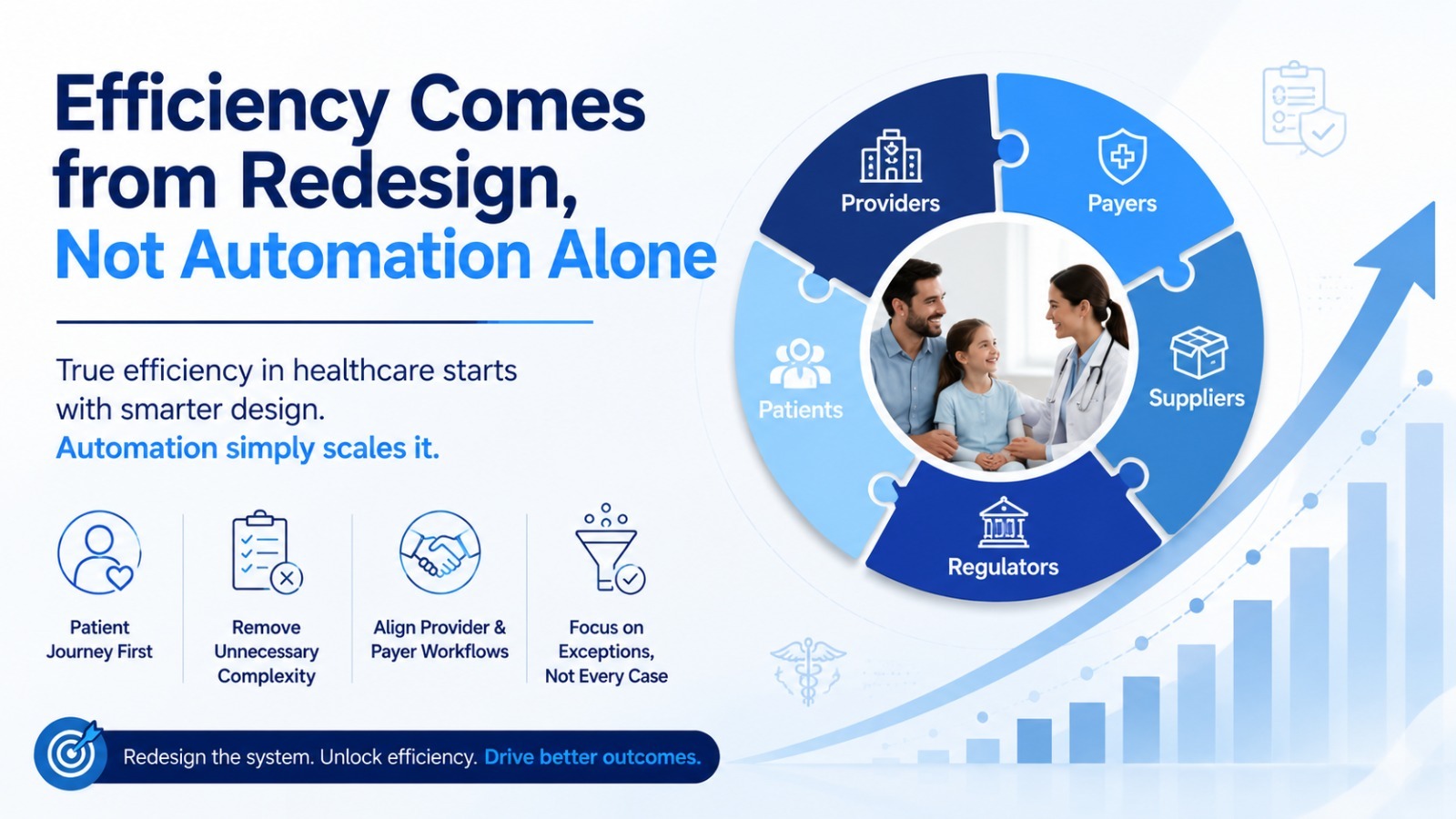
Efficiency Comes from Redesign, Not with Automation Alone
In healthcare, efficiency is often mistaken for speed.
- Hospitals want faster patient throughput.
- Insurers want quicker claims processing.
- Medical device companies want shorter delivery cycles.
The instinctive solution? Automation.
But after working across healthcare delivery and insurance ecosystems, one thing is clear:
Automation alone does not create efficiency.
It only scales whatever system already exists—good or bad.
The Missing Strategic Layer
Healthcare is unique. It is not a linear system—it is a complex, interdependent network involving:
- Providers
- Payers (insurance)
- Suppliers
- Regulators
- Patients
Each operates with its own processes, incentives, and constraints.
When automation is introduced without redesign, it typically optimizes individual silos—not the end-to-end patient and payment journey.
And that is where inefficiency truly lives.
A Dual Perspective: Provider vs Insurance
From the Provider Side
Hospitals often focus on:
- Reducing administrative workload
- Digitizing clinical workflows
- Improving patient turnaround
Yet inefficiencies persist because:
- Documentation is repeated across systems
- Approvals delay care pathways
- Billing structures are complex and inconsistent
From the Insurance Side
Payers invest heavily in:
- Claims automation
- Fraud detection systems
- Pre-authorization platforms
But still face:
- High claim rejection rates
- Rework cycles
- Provider friction
Why?
Because the process itself is fragmented, not just slow.
The Core Issue: Misaligned Design
Most inefficiencies in healthcare are designed into the system:
- Multiple approval layers to manage risk
- Redundant documentation for compliance
- Disconnected data systems across stakeholders
When you automate this environment, you don’t eliminate friction—you digitize it.
What Redesign Really Means
Redesign is not a cosmetic improvement. It is a strategic rethinking of how value flows across the ecosystem.
It requires asking uncomfortable questions:
- Why does this approval exist?
- Can risk be managed differently?
- Can data be captured once and used universally?
- Are we optimizing for the organization—or the patient journey?
A Strategic Approach to Efficiency
To truly unlock efficiency, healthcare leaders must move beyond incremental improvements and adopt a system-wide view:
-
Redesign Around the Patient Journey
Instead of optimizing isolated functions, redesign processes around:
- Patient flow
- Clinical outcomes
- Financial transparency
-
Align Provider–Payer Workflows
A significant portion of inefficiency sits at this interface:
- Pre-authorizations
- Claims submissions
- Coding discrepancies
Standardization and shared frameworks can remove entire layers of friction.
-
Shift from Control-Based to Exception-Based Models
Many processes are designed for control, not efficiency:
- Every case requires approval
- Every claim is scrutinized
Redesign introduces:
- Automated approvals for standard cases
- Focused review for exceptions
-
Simplify Before You Digitize
Eliminate:
- Redundant touchpoints
- Duplicate data entry
- Non-value-adding approvals
Only then introduce automation.
Where Automation Fits
Automation is still critical—but its role must be clear:
- It accelerates clean processes
- It enhances scalability
- It improves consistency
But it cannot:
- Fix flawed system design
- Resolve stakeholder misalignment
- Replace strategic thinking
Why This Matters Now
Across the Middle East and Africa, healthcare systems are evolving rapidly:
- Insurance penetration is increasing
- Regulatory frameworks are strengthening
- Patient expectations are rising
At the same time, cost pressures are intensifying.
This makes efficiency not just an operational goal—but a strategic imperative.
Organizations that rely only on automation will hit a ceiling.
Those that invest in redesign will fundamentally change their cost structures and service delivery models.
Final Thought
In healthcare, efficiency is not about doing things faster.
It is about doing the right things, in the right way, across the entire ecosystem.
Automation is a powerful tool—but strategy determines whether it creates value or amplifies complexity.
The real question for leaders is: