

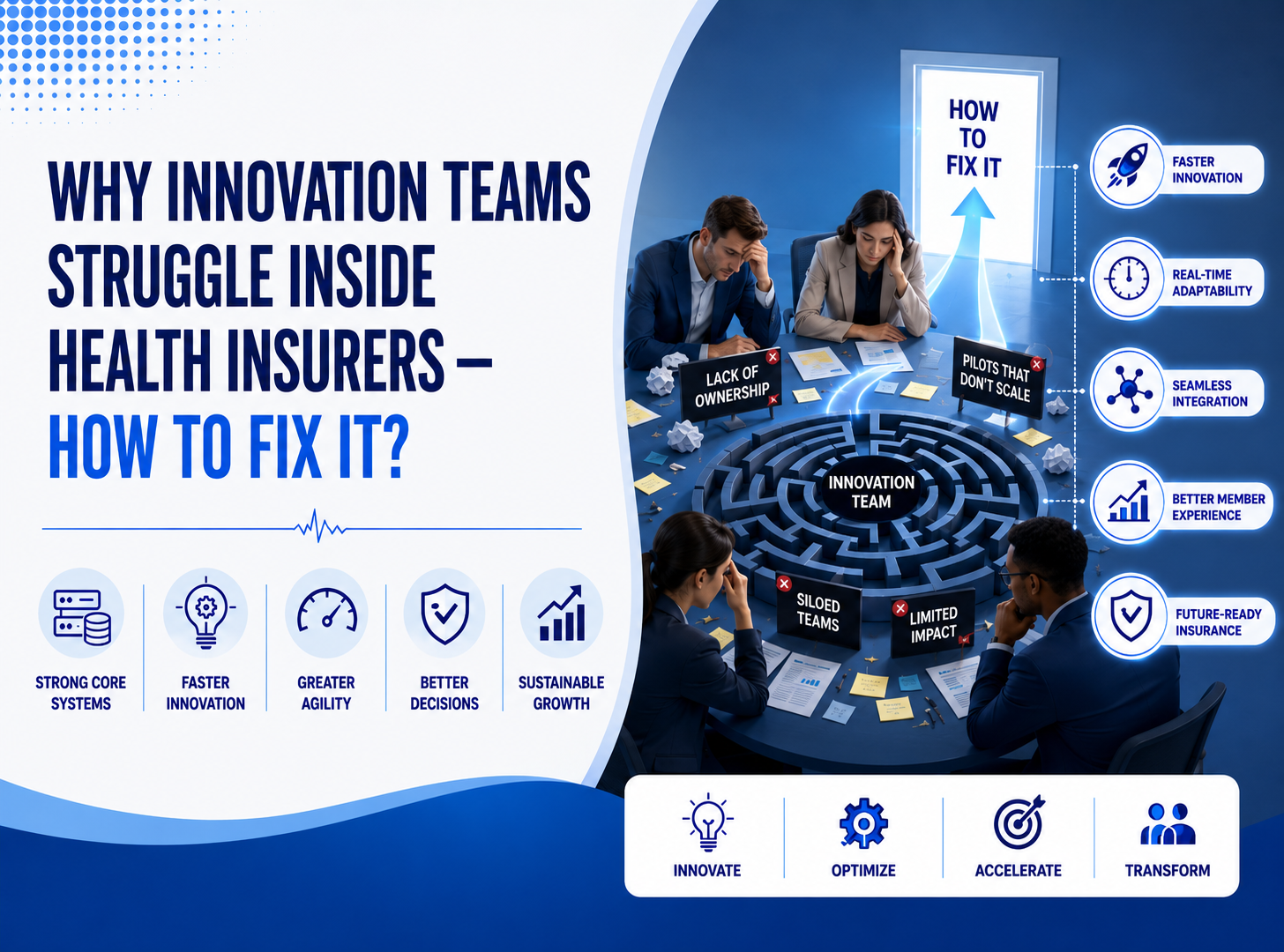
Why Innovation Teams Struggle Inside Health Insurers — How to Fix It?

Innovation has become a strategic imperative across the healthcare landscape. From value-based care to digital health, insurers are under immense pressure to evolve OR risk becoming obsolete. Many organizations have responded by building innovation teams, launching incubators, or funding pilot programs.
And yet, despite strong intent and investment, the results are often underwhelming.
The issue is rarely a lack of ideas or talent. More often, innovation struggles because it operates without true outcome ownership.
The Innovation Paradox in Healthcare
Health insurers are uniquely complex organizations. They operate at the intersection of clinical outcomes, regulatory scrutiny, cost management, and member experience. This complexity creates a paradox:
- Innovation is urgently needed
- But structural realities make it difficult to implement and scale
Common symptoms of this paradox include:
- Pilots that never scale
- Solutions that don’t integrate into core operations
- Innovation teams perceived as “adjacent” rather than essential
- Limited measurable impact on cost, quality, or member outcomes
At the center of this challenge lies a critical gap: who owns the outcome?
The Core Problem: Innovation Without Ownership
In many insurers, innovation teams are set up as separate units—tasked with exploring ideas, testing solutions, and driving transformation. While this structure provides focus, it often creates unintended consequences:
Separation from Core Business
Innovation teams are typically not directly accountable for P&L, clinical outcomes, or operational KPIs. This disconnect leads to solutions optimized for pilots, not real-world constraints, limited urgency to solve deeply embedded problems, difficulty gaining buy-in from operational leaders.
Lack of Accountability for Results
When innovation teams are measured on activity (e.g., number of pilots) rather than outcomes (e.g., reduction in claims costs, improved patient adherence), success becomes ambiguous.
Without ownership of measurable results: Projects drift, Priorities shift and Impact becomes difficult to prove.
Fragmented Decision-Making
Scaling an innovation across underwriting, claims, provider networks, and member engagement requires cross-functional alignment. Without a single accountable owner: Decisions slow down, Responsibility diffuses, Execution falters.
Why Outcome Ownership Matters
True innovation in healthcare is not about launching new ideas—it is about delivering measurable impact at scale.
Outcome ownership changes the equation in three important ways:
Aligns Innovation with Business Value
Drives Execution Discipline
Accelerates Adoption
Operational teams are more likely to adopt solutions when they are co-owned or when accountability is clearly defined. Innovation becomes “our initiative” rather than “their project.”
A More Effective Model
To unlock meaningful impact, healthcare organizations can adopt a few practical shifts:
- Define Clear Outcomes Upfront
- Assign a Single Accountable Owner
- Co-Create with Operations
- Measure What Matters
- Plan for Scale from Day One
My Thoughts…
Innovation in healthcare is not about doing more, it’s about doing what matters, and making it work at scale.
When outcome ownership becomes central, innovation stops being a side function and starts becoming a true driver of transformation.
And that’s where real value is created for organizations, providers, and most importantly, patients.
Let me know what you think…