
Reactive vs. Predictive Healthcare: What’s Changing?
For decades, healthcare systems around the world have primarily relied on a reactive healthcare model—patients seek medical attention only after symptoms appear, diseases are diagnosed, and treatment begins. While this approach has saved countless lives, it often addresses illnesses after they have already progressed, leading to more complex treatments, higher healthcare costs, and poorer patient outcomes.
Today, healthcare is entering a new era powered by Artificial Intelligence (AI), predictive analytics, wearable technology, Electronic Health Records (EHRs), remote patient monitoring (RPM), and big data. Instead of waiting for diseases to develop, healthcare providers can now identify health risks earlier, predict future complications, and take preventive actions before symptoms even appear.
What Is Reactive Healthcare?
Reactive healthcare focuses on diagnosing and treating illnesses after symptoms become noticeable.
For example, a patient experiencing severe chest pain visits the emergency department, undergoes diagnostic tests, receives a diagnosis, and then begins treatment. Likewise, conditions such as diabetes or hypertension are often detected only after months—or even years—of silent progression.
Although reactive healthcare remains essential for emergency medicine, trauma care, infections, and acute illnesses, it is less effective for preventing chronic diseases that develop gradually over time.
What Is Predictive Healthcare?
Predictive healthcare uses Artificial Intelligence, machine learning, predictive analytics, wearable devices, and patient data to identify health risks before symptoms develop.
Rather than asking:
“How do we treat this disease?”
Predictive healthcare asks:
“How can we prevent this disease from happening?”
Healthcare providers combine multiple sources of patient information, including:
- Electronic Health Records (EHR)
- Laboratory reports
- Medical imaging
- Genetic information
- Lifestyle habits
- Wearable device data
- Remote monitoring devices
- Family medical history
AI algorithms analyze this information to identify patterns, estimate disease risk, and recommend personalized preventive interventions.
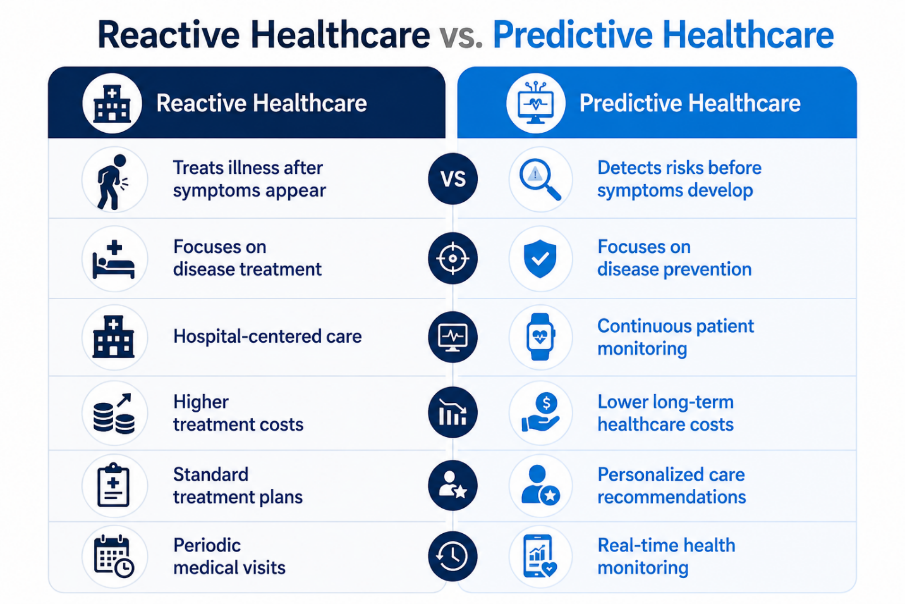
Reactive Healthcare vs. Predictive Healthcare
Benefits of Predictive Healthcare
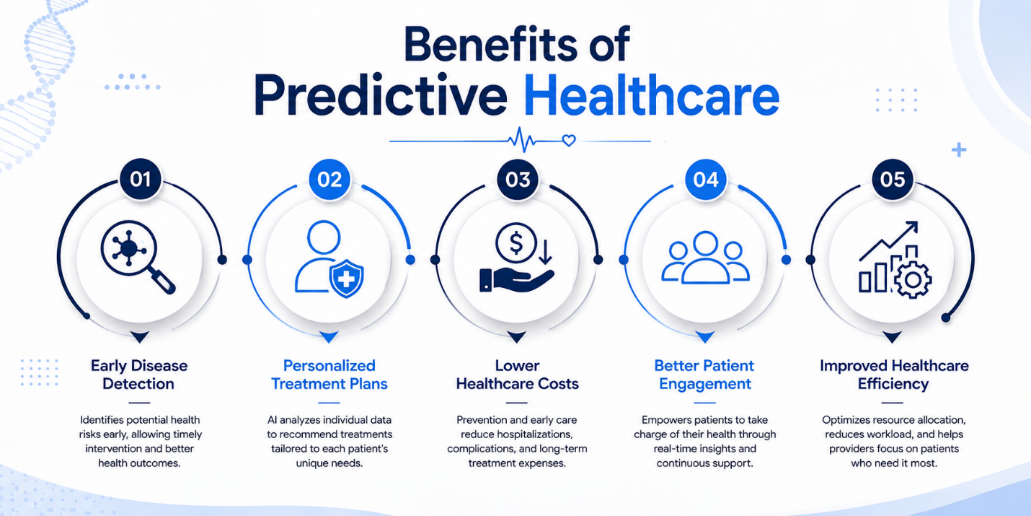
Early Disease Detection
Predictive healthcare enables earlier identification of conditions such as:
- Heart disease
- Diabetes
- Cancer
- Kidney disease
- Stroke
- Respiratory disorders
Earlier diagnosis often leads to more effective treatment and better survival rates.
Personalized Treatment Plans
Personalized medicine improves treatment effectiveness while reducing unnecessary interventions.
Lower Healthcare Costs
Preventing disease is significantly less expensive than treating advanced illness.
Better Patient Engagement
Mobile health applications and wearable devices empower patients to actively participate in managing their own health.
Improved Healthcare Efficiency
Healthcare organizations can prioritize high-risk patients, optimize staffing, reduce clinician burnout, and improve operational efficiency using AI-assisted clinical decision support.
This allows healthcare professionals to spend more time delivering quality patient care.
Real-World Applications of Predictive Healthcare
Cardiovascular Disease Prevention
AI analyzes ECG readings, cholesterol levels, blood pressure, medical history, and lifestyle habits to predict heart attacks and strokes before symptoms occur.
Diabetes Management
Continuous glucose monitors (CGMs) combined with AI detect abnormal blood sugar trends, helping physicians adjust treatments and prevent serious complications.
Early Cancer Detection
AI-powered imaging systems improve diagnostic accuracy by identifying subtle abnormalities in:
- Mammograms
- X-rays
- CT scans
- MRI scans
- Pathology slides
Earlier detection significantly increases treatment success rates.
Mental Health Monitoring
Digital mental health platforms analyze:
- Sleep quality
- Behavioral changes
- Smartphone usage
- Patient-reported outcomes
to identify early signs of anxiety, depression, and stress-related disorders.
Elderly Care
Smart home sensors, wearable devices, and AI-powered monitoring systems detect:
- Falls
- Reduced mobility
- Abnormal heart rate
- Missed medications
- Changes in daily routines
Caregivers receive instant alerts, improving safety and independence for older adults.
Challenges in Predictive Healthcare
Despite its enormous potential, predictive healthcare faces several important challenges.
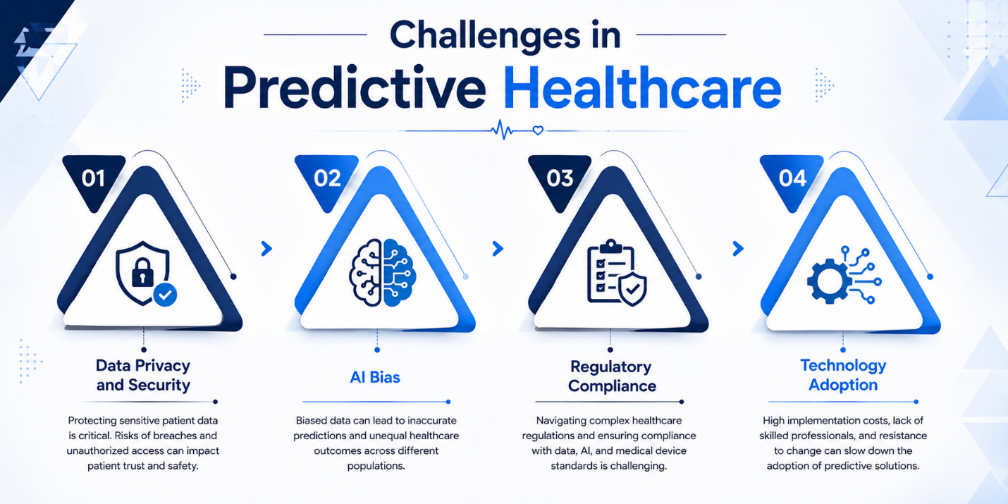
Data Privacy and Security
Healthcare organizations must safeguard sensitive patient information through robust cybersecurity measures, encryption, and compliance with privacy regulations.
AI Bias
Artificial Intelligence systems require diverse, representative datasets to ensure accurate and equitable predictions across different populations.
Reducing algorithmic bias is essential for delivering fair healthcare outcomes.
Regulatory Compliance
Healthcare providers must comply with strict regulations governing:
- Patient safety
- Medical devices
- AI governance
- Data protection
- Clinical validation
Regulatory compliance is critical for building trust in AI-powered healthcare solutions.
Technology Adoption
Successful implementation requires investment in:
- Digital infrastructure
- Staff training
- AI integration
Frequently Asked Questions (FAQs)
What is the difference between reactive and predictive healthcare?
Reactive healthcare treats illnesses after symptoms appear, while predictive healthcare uses AI, analytics, and patient data to identify health risks early and prevent diseases before they develop.
How does AI improve predictive healthcare?
AI analyzes medical records, wearable device data, imaging, laboratory reports, and genetic information to detect disease patterns, predict health risks, and support early intervention.
What technologies are used in predictive healthcare?
Predictive healthcare relies on Artificial Intelligence (AI), Machine Learning, Electronic Health Records (EHR), wearable devices, remote patient monitoring, predictive analytics, big data, and cloud computing.
What are the benefits of predictive healthcare?
Key benefits include early disease detection, personalized treatment, reduced healthcare costs, improved patient engagement, continuous monitoring, and better healthcare efficiency.
Why is predictive healthcare important for the future?
Predictive healthcare enables healthcare providers to prevent diseases, improve patient outcomes, optimize medical resources, and create a more sustainable and patient-centric healthcare system.
Conclusion
The shift from reactive healthcare to predictive healthcare marks one of the most significant transformations in modern medicine. By leveraging Artificial Intelligence, predictive analytics, wearable technology, remote patient monitoring, Electronic Health Records, and big data, healthcare providers can identify health risks earlier, personalize treatment, and prevent diseases before they become life-threatening.
For forward-thinking organizations like Alpha Health, embracing predictive healthcare is more than adopting advanced technology—it’s about creating a future where prevention becomes the foundation of patient care. As digital health continues to evolve, predictive healthcare will play a central role in building healthier communities, improving clinical outcomes, reducing healthcare costs, and delivering smarter, more sustainable healthcare systems.