


Rapid Tests vs Traditional Lab Tests: What’s the Difference and When Should You Use Which?
Medical testing has become a routine part of modern healthcare—from pregnancy confirmation and infection screening to hormone monitoring and chronic disease management. Yet, one question continues to confuse patients:
Should I choose a rapid test or a traditional lab test?
Both play critical roles in diagnosis and care, but they serve very different purposes. Understanding when to use each can save time, reduce anxiety, and help you make informed health decisions.
This article breaks down the differences in simple terms—so you know what each test does, how accurate it is, and when it’s the right choice for you.
What Are Rapid Tests?
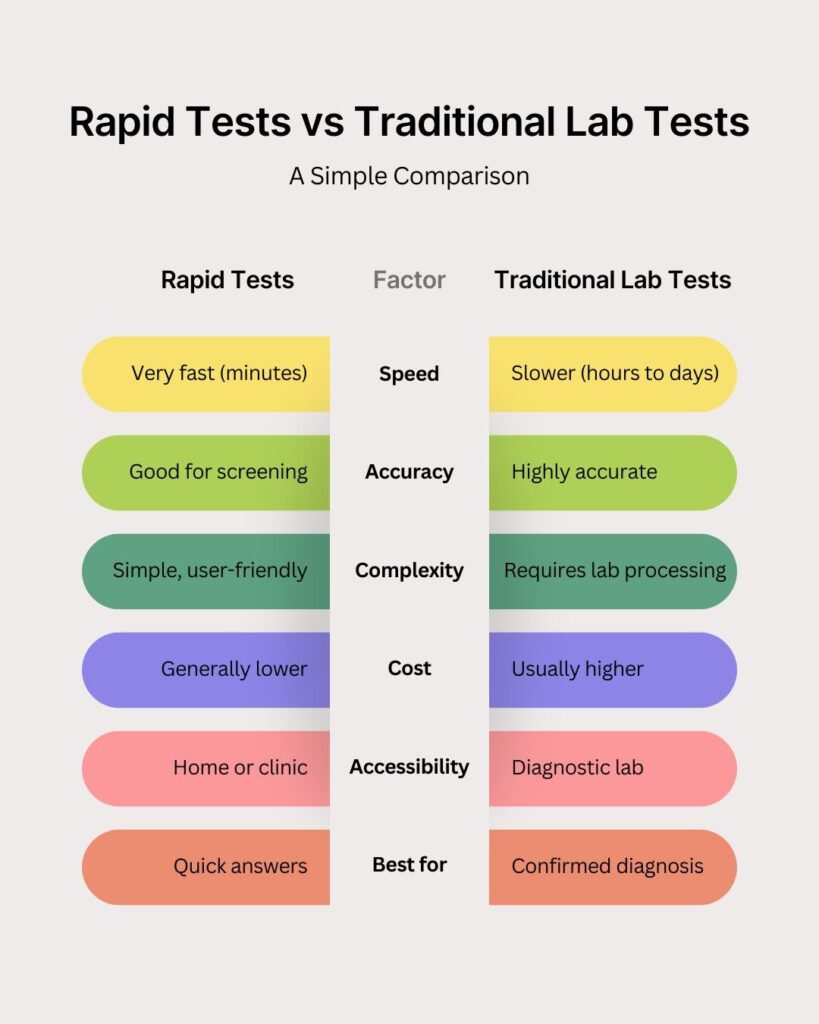
Rapid tests are quick diagnostic tools designed to deliver results within minutes, often at the point of care or even at home.
Key Features of Rapid Tests:
- Results available in 5–30 minutes
- Minimal equipment required
- Can be performed at clinics, pharmacies, or home
Easy to use, often with visual indicators (lines, color changes, digital readings)
Common Examples of Rapid Tests:
- Pregnancy tests
- Ovulation tests
- COVID-19 rapid antigen tests
- Blood glucose tests
- Rapid tests for infections like malaria, dengue, or influenza
Rapid tests are especially useful when immediate decisions are needed or when access to a laboratory is limited.
What Are Traditional Lab Tests?
Traditional lab tests involve collecting a sample—such as blood, urine, or swab—and sending it to a certified diagnostic laboratory for detailed analysis.
Key Features of Lab Tests:
- Results typically take hours to a few days
- Performed using advanced laboratory equipment
- Conducted and interpreted by trained professionals
- Higher sensitivity and specificity
Common Examples of Lab Tests:
- Complete blood count (CBC)
- Hormone panels
- Thyroid function tests
- PCR tests
- Liver and kidney function tests
- Detailed infection panels
Lab tests are the gold standard when precision and confirmation are essential.
When Should You Use a Rapid Test?
Rapid tests are ideal when you need quick information to guide immediate action.
Use a Rapid Test When:
- You need instant reassurance or screening
- Symptoms are mild or early
- You’re monitoring a condition regularly (like glucose levels)
- You’re checking fertility or pregnancy status
- You’re in a setting where lab access is limited
Example:
A home pregnancy test can confirm a suspected pregnancy within minutes, allowing you to take early precautions even before visiting a doctor.
When Should You Choose a Traditional Lab Test?
Lab tests are essential when accuracy, detail, and medical decisions depend on results.
Choose a Lab Test When:
- You need confirmed or diagnostic-level accuracy
- Symptoms persist despite a negative rapid test
- Your doctor needs baseline or comparative data
- You’re monitoring chronic or hormonal conditions
- Test results will influence treatment plans
Example:
If a rapid test suggests an infection, a lab test can identify the exact strain and guide the right medication.
Are Rapid Tests Reliable?
Rapid tests are clinically validated and safe when used correctly—but they are primarily designed for screening, not final diagnosis.
Important to Know:
- Rapid tests may produce false negatives if used too early
- Improper sample collection can affect results
- A negative rapid test doesn’t always rule out a condition
That’s why healthcare professionals often recommend follow-up lab testing if symptoms continue.
How Doctors Use Both Tests Together
Modern healthcare doesn’t treat rapid and lab tests as competitors—they are complementary tools.
A Common Testing Approach:
- Rapid test for immediate screening
- Lab test for confirmation or deeper analysis
- Treatment decisions based on combined insights
This layered approach improves speed without compromising accuracy.
Choosing the Right Test: What Really Matters
When deciding between a rapid test and a lab test, consider:
- Urgency – Do you need answers now?
- Purpose – Screening or diagnosis?
- Symptoms – Mild, severe, or ongoing?
- Doctor’s advice – Always prioritize professional guidance
Your healthcare journey is unique, and the “right” test depends on your situation, not just convenience.
Final Thoughts
Rapid tests and traditional lab tests each have their place in modern medicine. One offers speed and convenience, the other delivers depth and certainty.
Understanding the difference helps you:
- Avoid unnecessary panic
- Seek timely medical care
- Make informed decisions about your health
When used wisely—and often together—these testing methods become powerful allies in proactive healthcare.