

How Remote Patient Monitoring is Transforming Hospital Care
Introduction
Hospitals are the heart of healthcare delivery, yet the growing patient load, staff shortages, and the need for constant vigilance often strain even the best medical systems. As healthcare continues to evolve, Remote Patient Monitoring (RPM) has emerged as a transformative solution to these challenges.
With RPM technology, hospitals can continuously track patients’ vital signs in real time, automate early warning alerts, and provide clinicians with actionable insights without constant manual intervention. The result is improved patient safety, higher efficiency, and better outcomes across departments.
Alpha Health’s Dozee system is at the forefront of this evolution, offering continuous, and AI-powered monitoring that brings ICU-level intelligence to every hospital bed.
What is Remote Patient Monitoring in Hospitals?
Remote Patient Monitoring (RPM) involves using smart, connected devices to collect and transmit patients’ vital data such as heart rate, respiration rate, SpO₂, and movement to hospital dashboards in real time.
Unlike manual spot checks or intermittent assessments, RPM provides round-the-clock visibility, allowing medical teams to detect early signs of patient deterioration before it becomes critical.
In hospitals, systems like Dozee act as a silent guardian, tracking patients’ health continuously and sending timely alerts to nursing stations or doctors for swift action.
Why Hospitals Need RPM Systems
Modern hospitals face mounting pressure to improve quality of care while optimizing resources. Traditional patient monitoring systems often limit visibility to ICUs or require extensive manual effort. RPM expands that reach by offering ICU-grade monitoring across wards, step-down units, and general beds without additional infrastructure or manpower.
Here’s why hospitals are rapidly adopting RPM systems like Dozee:
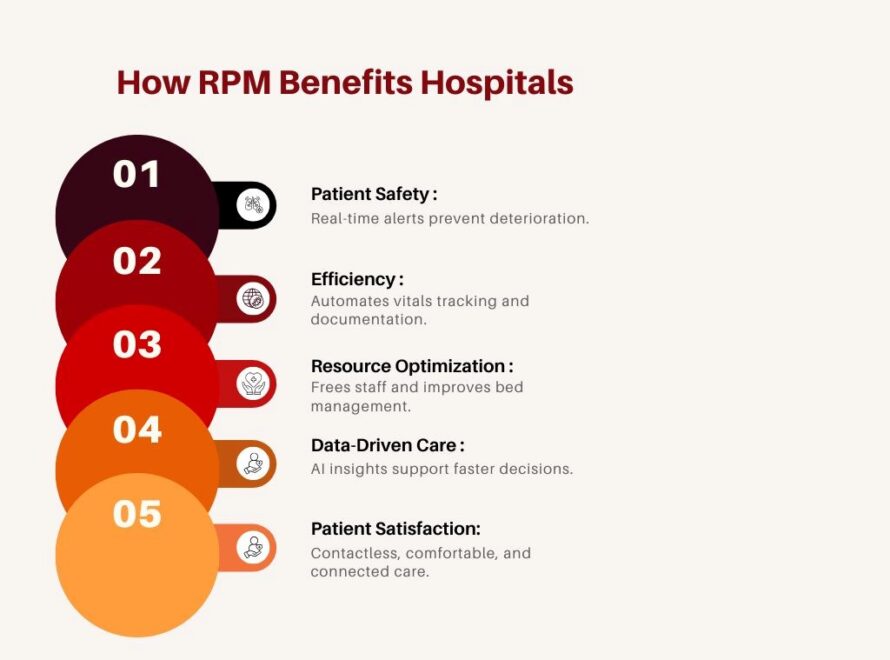
1. Enhanced Patient Safety
RPM ensures that no patient is left unmonitored. Continuous tracking of vital signs enables early detection of clinical deterioration, preventing medical emergencies and saving lives.
- AI algorithms identify deviations in heart rate, respiration, and oxygen levels long before visible symptoms appear.
- Automated alerts allow nurses and doctors to intervene instantly.
- Reduces instances of cardiac arrests or code blue events.
Result: Hospitals achieve measurable improvement in patient outcomes and safety compliance.
2. Real-Time Insights for Faster Clinical Decisions
In traditional ward setups, vital checks happen every few hours. RPM changes that by providing real-time, data-backed insights that empower medical teams to make faster and more accurate decisions.
- Continuous data helps clinicians recognize subtle health changes.
- AI-generated reports reduce guesswork and support evidence-based treatment.
- Multi-patient dashboards enable doctors to monitor several cases simultaneously.
Result: Faster decisions, improved diagnostics, and personalized care for every patient.
3. Improved Operational Efficiency
Staffing challenges are a reality in hospitals worldwide. RPM helps optimize nurse workloads and streamline workflows by automating repetitive monitoring tasks.
- Reduces manual vital checks and documentation effort.
- Allows nurses to focus more on patient care and less on routine data collection.
- AI-based triaging helps prioritize high-risk patients, ensuring the right attention at the right time.
- Result: Increased productivity, reduced burnout, and better utilization of medical staff.
4. Better Resource Management and Bed Turnover
With real-time visibility into each patient’s condition, hospitals can make data-driven decisions on discharge timing, transfers, and treatment plans.
- Patients showing faster recovery can be safely moved to step-down units or discharged earlier.
- Remote oversight ensures continued safety even in lower-dependency wards.
- Faster recovery and turnover improve hospital capacity and revenue.
Result: Smarter bed management and improved operational throughput.
5. Seamless Integration with Hospital Systems
Modern RPM solutions like Dozee integrate easily with existing Hospital Information Systems (HIS) and Electronic Medical Records (EMR) platforms.
This creates a unified data ecosystem where every patient’s vital stats, medical history, and alerts are accessible in one place.
Benefits include:
- Centralized data for all departments.
- Real-time communication between nurses, doctors, and admin teams.
- Accurate documentation for compliance and audits.
Result: Improved coordination and reduced administrative errors.
6. Reduction in ICU Transfers and Readmissions
RPM identifies deterioration early, enabling hospitals to take preventive action before conditions worsen. This directly reduces the number of ICU transfers and readmissions.
- Early detection of sepsis, respiratory failure, or cardiac instability.
- Post-surgery patients can be safely monitored in wards instead of prolonged ICU stays.
- Data trends help physicians optimize recovery protocols.
- Result: Reduced hospital costs, better patient outcomes, and improved quality metrics.
7. Increased Patient Trust and Satisfaction
Patients feel safer knowing they are being monitored continuously. The sense of security provided by RPM technology builds trust and reassurance.
- Patients experience personalized, attentive care even in general wards.
- Families gain peace of mind with real-time visibility into health updates.
- Contactless systems like Dozee improve comfort and hygiene by eliminating invasive wires and probes.
Result: Higher patient satisfaction and stronger hospital reputation.
8. Advanced Analytics and Predictive Intelligence
AI-driven RPM systems generate a wealth of data that can be analyzed to identify patterns, predict risks, and improve clinical strategies.
- Predictive analytics helps forecast patient deterioration before critical events.
- Trend data supports hospital-wide quality improvement initiatives.
- Long-term data analysis enables better planning for chronic care management.
Result: Hospitals evolve from reactive to predictive care models.
How Alpha Health’s Dozee Leads the Change
Dozee, powered by Alpha Health, is an advanced introduced remote monitoring system that converts any bed into a smart hospital bed.
How it works:
A smart sensor sheet is placed under the mattress to capture micro-vibrations from the patient’s body, monitoring parameters like heart rate, respiration, and movement, all without direct contact.
The data is transmitted securely to hospital dashboards, enabling continuous observation from the nursing station or mobile app.
Key features:
- Contactless and wireless setup for comfort and hygiene.
- AI-based alerts for early detection of deterioration.
- Centralized dashboards for multi-patient management.
- Seamless integration with HIS and EMR systems.
- Scalable for wards, ICUs, or post-surgery recovery rooms.
Impact:
Hospitals using Dozee have reported:
- 30% reduction in code blue events
- 50% reduction in manual monitoring time
- 25% improvement in nurse efficiency
- Faster clinical interventions and better outcomes
Conclusion
Remote Patient Monitoring is no longer a futuristic concept; it is a necessity for modern hospitals aiming to deliver safer, smarter, and more efficient care.
By providing 24×7 visibility into patients’ health, RPM helps clinicians act faster, optimize resources, and improve recovery outcomes.
With solutions like Dozee, hospitals can transform ordinary beds into intelligent care systems that work round the clock, protecting lives, supporting staff, and redefining patient care excellence.
The future of hospital care is here — connected, predictive, and continuous.