
AI in Healthcare: The Bridge Between Early Detection and Better Outcomes
Introduction
Healthcare is undergoing a digital transformation, and at the heart of this revolution lies Artificial Intelligence (AI). From predicting cardiac arrest hours before it happens to identifying subtle changes in a patient’s vitals that the human eye might miss, AI is becoming the silent guardian of modern medicine.
AI isn’t just automating data; it’s interpreting it, learning from it, and alerting healthcare professionals to act before complications arise. This ability to detect early warning signs and guide medical decisions is redefining patient outcomes and reshaping the healthcare ecosystem.
The Shift Toward Predictive and Preventive Care
Traditionally, healthcare has been reactive, treating conditions after they occur. But AI is flipping the script. By analyzing vast amounts of patient data in real-time, AI-driven systems can predict risks before symptoms even appear.
For example, AI models trained on millions of medical records can recognize subtle indicators of diseases like sepsis, stroke, or cardiac failure. When integrated into hospital systems or continuous monitoring devices, these algorithms can trigger early alerts, allowing doctors to intervene well before a crisis develops.
This shift from treatment to prevention not only saves lives but also reduces hospital stays and healthcare costs dramatically.
How AI Enhances Early Detection
- Real-Time Vital Monitoring
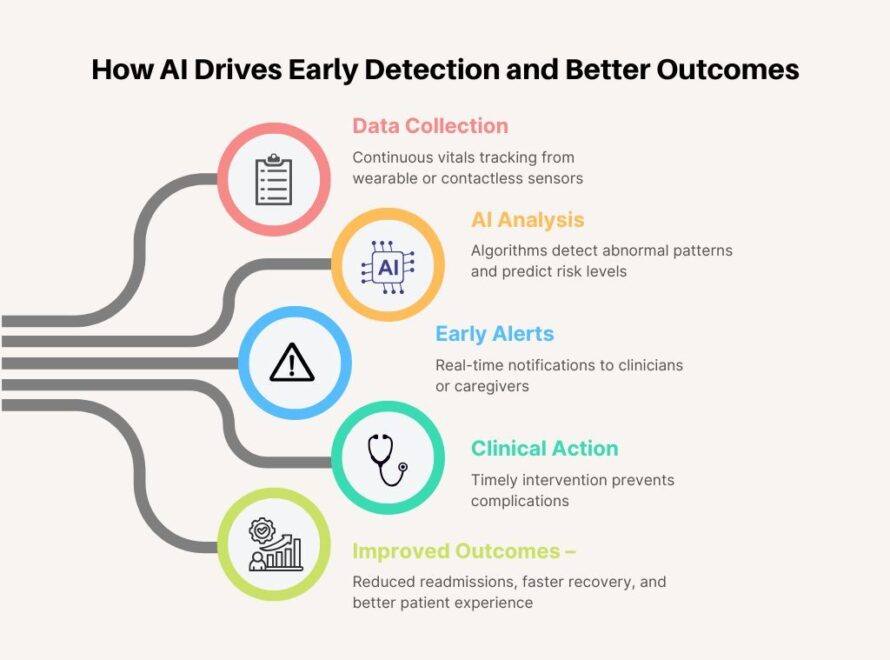
AI-powered patient monitoring systems, like continuous contactless solutions offered by companies such as Alpha Health, collect and analyze physiological data 24/7. Parameters like heart rate, oxygen saturation, and respiration are continuously tracked.
When deviations occur, AI detects anomalies early and alerts clinicians instantly, ensuring prompt response. - Pattern Recognition Beyond Human Limits
AI algorithms can identify patterns invisible to the human eye. For example, a small but consistent change in sleep patterns or heart rate variability might signal early deterioration.
These insights, when delivered through intuitive dashboards, allow healthcare teams to prioritize patients at higher risk. - Predictive Analytics and Machine Learning Models
Machine learning models evolve continuously as they process more data. Over time, they improve accuracy, predicting events like cardiac arrests or respiratory decline with impressive precision.
AI as a Clinical Decision Support Partner
AI doesn’t replace doctors; it empowers them. Clinical Decision Support Systems (CDSS) powered by AI assist healthcare professionals in diagnosing, prioritizing, and managing patients more effectively.
For instance:
- AI-driven imaging tools detect early-stage cancers, fractures, or infections from scans faster and more accurately than manual review.
- Automated data analysis helps clinicians correlate lab results, vitals, and medical history to suggest the most probable diagnosis.
- Virtual assistants powered by natural language processing (NLP) summarize patient data and highlight urgent issues, saving valuable time.
This collaborative model ensures that AI enhances human expertise rather than substituting it.
Improving Patient Outcomes Through Continuous Intelligence
AI’s true strength lies in continuity. Unlike manual assessments, AI systems never tire, never overlook data, and never miss trends. Continuous monitoring across hospital wards and home-based care environments ensures that no warning sign goes unnoticed.
- In Hospitals: AI detects deterioration early in high-dependency wards, helping clinicians act swiftly.
- At Home: Remote patient monitoring (RPM) devices use AI to oversee recovering or chronic patients, alerting care teams to intervene when necessary.
- Across Networks: AI platforms enable unified health data sharing between hospitals, doctors, and caregivers, ensuring patients receive consistent, informed care wherever they are.
Ultimately, this continuous feedback loop drives better outcomes, minimizes readmissions, and enhances the overall quality of care.
Challenges and Ethical Considerations
As with any innovation, AI in healthcare brings its own set of challenges:
- Data Privacy: Protecting patient data is paramount. Strong encryption and compliance with medical data regulations (like HIPAA) are essential.
- Algorithm Bias: AI learns from data. If the data is biased, outcomes may be too. Diverse datasets are critical for fair predictions.
- Human Oversight: AI should support, not replace, clinical judgment. Human validation remains crucial in decision-making.
When implemented ethically, AI becomes a trusted ally, not a risk.
The Future of AI-Driven Healthcare
The next phase of AI in healthcare will see deeper integration between smart monitoring devices, hospital systems, and telehealth ecosystems. Imagine a world where:
- AI detects illness before symptoms arise.
- Doctors receive automated insights in real-time.
- Patients recover faster because intervention happens earlier.
This is not a distant dream; it’s happening now. AI-powered monitoring platforms like those developed by Alpha Health are already transforming the way care is delivered, bridging hospitals, homes, and remote clinics through intelligent, continuous observation.
Conclusion
AI is more than just technology; it’s a bridge between early detection and better patient outcomes. By turning data into foresight, AI ensures that healthcare becomes proactive, personalized, and predictive.
As we move toward a world where machines and medicine work hand in hand, one thing is certain: AI is not replacing care; it’s redefining it.