

How AI Is Redefining Patient Safety
Healthcare is becoming more connected, data-driven, and technology-enabled than ever before. From electronic health records and connected medical devices to remote monitoring and digital diagnostics, healthcare providers now have access to enormous amounts of information.
The challenge is turning that information into timely action.
This is where AI in healthcare is making a significant difference. Artificial intelligence can analyze large volumes of clinical data, identify patterns, predict potential risks, support clinical decisions, and help healthcare professionals detect problems earlier.
For patient safety, this shift is particularly important. The World Health Organization (WHO) estimates that around 1 in 10 patients experience harm in healthcare, while more than half of this harm may be preventable. Medication errors, diagnostic errors, infections, falls, unsafe procedures, and patient misidentification remain important sources of avoidable harm.
AI does not replace healthcare professionals. Instead, when appropriately designed, validated, and governed, it can provide another layer of intelligence around clinical teams.
What Is AI in Healthcare?
Artificial intelligence in healthcare refers to technologies that use algorithms and data to perform tasks that traditionally require human intelligence.
These systems can process information, recognize patterns, generate predictions, classify medical images, identify potential risks, and support healthcare professionals with relevant information.
Why Patient Safety Needs AI
Modern healthcare is complex. A single patient may generate information from consultations, laboratory tests, imaging, medications, vital signs, medical histories, wearable devices, and multiple healthcare professionals.
Humans can struggle to continuously process all of this information.
AI systems can analyze large datasets rapidly and continuously, helping identify patterns that may otherwise be difficult to detect.
For example, an AI patient safety system could potentially identify a combination of abnormal vital signs, laboratory results, and clinical history that indicates an elevated risk of deterioration.
This creates an opportunity to intervene earlier.
WHO’s Global Patient Safety Report 2024 emphasizes the need for stronger patient safety systems, policies, data-driven improvement, and coordinated action across healthcare organizations.
AI can become one component of that broader safety infrastructure.
Benefits of AI-Powered Patient Safety
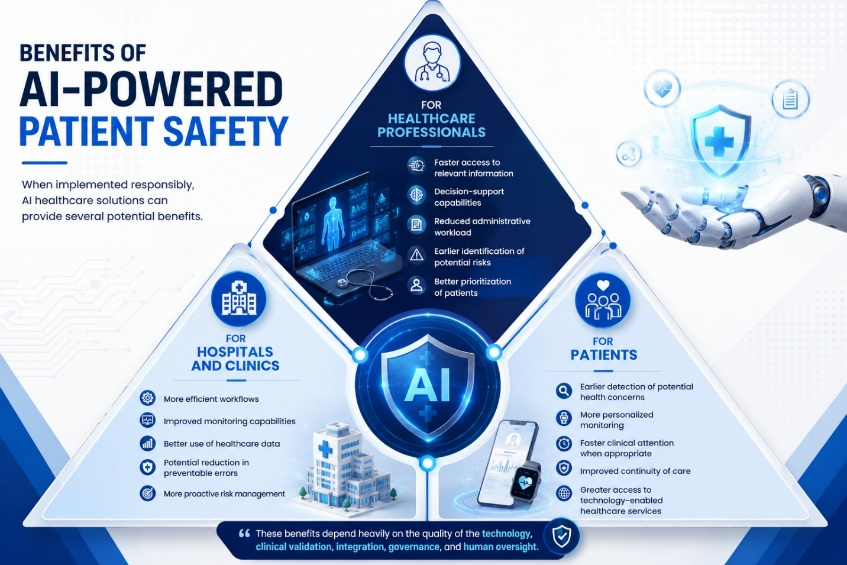
When implemented responsibly, AI healthcare solutions can provide several potential benefits.
These benefits depend heavily on the quality of the technology, clinical validation, integration, governance, and human oversight.
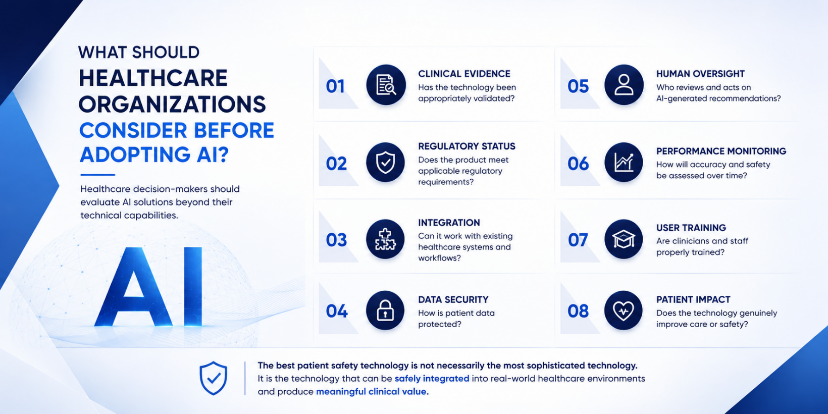
What Should Healthcare Organizations Consider Before Adopting AI?
Healthcare decision-makers should evaluate AI solutions beyond their technical capabilities.
Before implementation, organizations should consider:
The best patient safety technology is not necessarily the most sophisticated technology.
It is the technology that can be safely integrated into real-world healthcare environments and produce meaningful clinical value.
Frequently Asked Questions
- How does AI improve patient safety?
AI can analyze healthcare data to identify patterns, predict potential risks, support clinical decisions, monitor patients, detect abnormalities, and automate selected processes. These capabilities can provide healthcare professionals with additional information to support safer care.
- Can AI replace doctors in patient care?
No. AI is primarily a decision-support and information-processing technology. Qualified healthcare professionals remain responsible for clinical assessment, diagnosis, treatment decisions, and patient communication.
- What are examples of AI for patient safety?
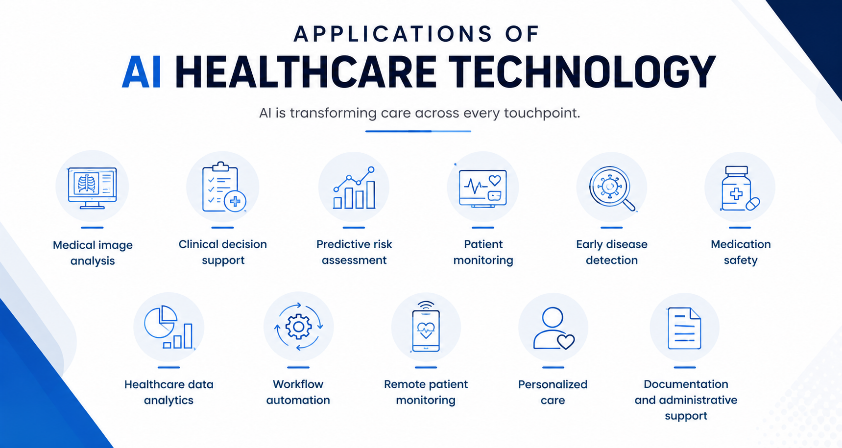
Examples include AI-powered patient monitoring, predictive risk models, AI-assisted medical imaging, medication safety systems, clinical decision support, early disease detection, and workflow automation.
- Is AI healthcare technology safe?
AI technology can support safer healthcare when it is properly validated, regulated, monitored, and implemented with human oversight. However, AI systems can also introduce risks such as bias, incorrect predictions, privacy concerns, and overreliance on automated outputs.
- How is AI changing predictive healthcare?
AI enables healthcare organizations to analyze large amounts of patient information and identify patterns associated with potential risks. This can support earlier intervention and move healthcare toward a more proactive model.
- Why is AI important for hospitals in the UAE?
The UAE has established national strategies and policies supporting AI adoption and healthcare innovation. AI can help UAE healthcare organizations explore advanced diagnostics, predictive analytics, personalized medicine, monitoring, and digital healthcare solutions.
Conclusion: Building a Safer Future With AI
AI in healthcare is moving patient safety toward a more predictive, connected, and data-driven future.
From AI-driven diagnostics and patient monitoring to predictive analytics and clinical decision support, healthcare AI solutions can help clinicians identify risks earlier, make better-informed decisions, and improve operational efficiency.
But successful adoption requires more than advanced algorithms.
Healthcare organizations need reliable technology, strong clinical validation, responsible governance, secure data practices, regulatory compliance, and human oversight.
For the UAE and wider GCC healthcare market, this represents a significant opportunity to bring proven global healthcare innovations closer to healthcare providers and patients.
At Alpha Health, we believe technology should ultimately serve one purpose: better healthcare outcomes.
As a trusted healthcare solutions provider and distributor of innovative medical technologies, Alpha Health helps connect global healthcare manufacturers with healthcare providers across the Middle East. By bringing advanced healthcare products and technologies closer to the organizations that need them, Alpha Health supports the region’s journey toward smarter, safer, and more efficient healthcare.