

AI in Early Detection: Sepsis, Shock, and Patient Deterioration in Remote Patient Monitoring
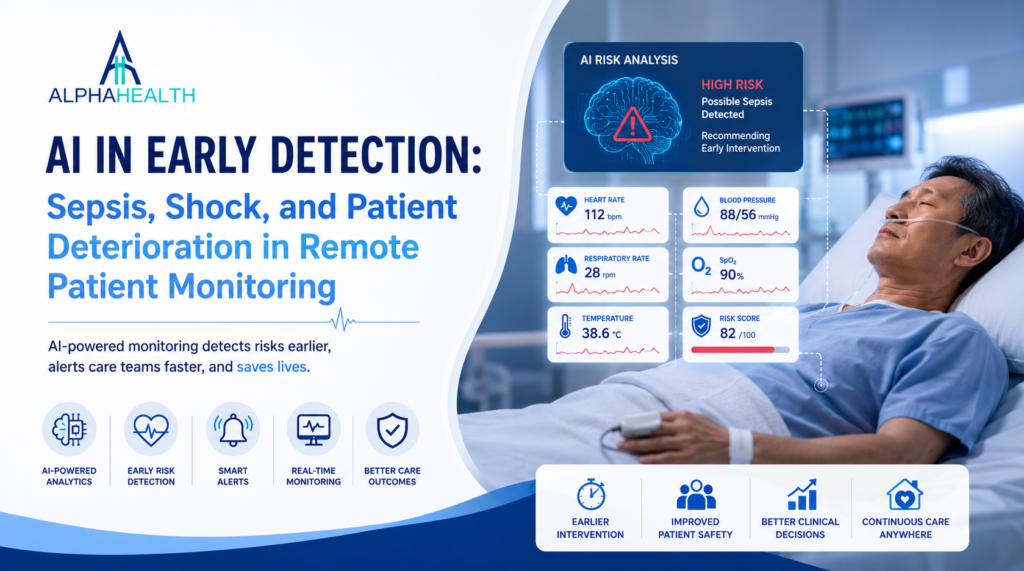
In healthcare, timing can mean the difference between recovery and crisis. Conditions like sepsis, shock, and sudden patient deterioration often progress silently before visible symptoms appear. Traditional monitoring methods may miss these early warning signs, especially in busy hospitals or during home care recovery.
This is where Artificial Intelligence (AI) combined with Remote Patient Monitoring (RPM) is transforming patient care. By continuously analyzing vital signs and identifying subtle physiological changes, AI-powered monitoring systems help healthcare providers detect risks earlier, respond faster, and improve patient outcomes.
What is Remote Patient Monitoring?
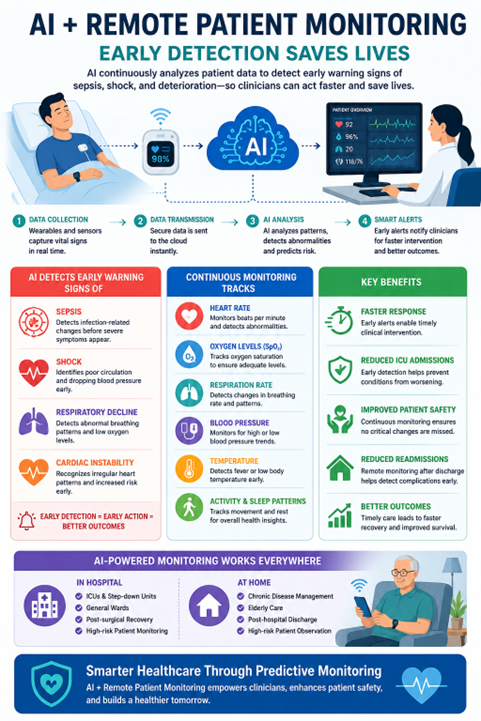
Remote Patient Monitoring is a healthcare technology that continuously tracks a patient’s vital signs and health data without requiring constant manual observation. Sensors and smart monitoring devices collect information such as:
- Heart rate
- Respiratory rate
- Oxygen saturation (SpO₂)
- Blood pressure
- Temperature
- Sleep and movement patterns
These systems send real-time data to healthcare professionals, allowing them to monitor patients both inside hospitals and remotely at home.
AI enhances this process by interpreting large volumes of patient data instantly and identifying abnormalities that may indicate medical deterioration.
Why Early Detection Matters
Critical illnesses rarely happen suddenly. In many cases, the body shows subtle warning signs hours before a patient becomes unstable. However, these changes may go unnoticed during routine checks.
Delayed intervention can lead to:
- ICU admissions
- Organ failure
- Longer hospital stays
- Increased healthcare costs
- Higher mortality rates
AI-powered monitoring helps identify these risks earlier, giving medical teams valuable time to act before the condition worsens.
Understanding Sepsis and Shock
Sepsis
Sepsis is a life-threatening condition caused by the body’s extreme response to infection. It can rapidly damage organs and become fatal if not treated early.
Early signs include:
- Increased heart rate
- Rapid breathing
- Fever or low body temperature
- Reduced oxygen levels
- Changes in blood pressure
AI systems can recognize these patterns long before severe symptoms become visible.
Shock
Shock occurs when the body is not receiving enough blood flow and oxygen to vital organs. It can result from infection, trauma, heart problems, or blood loss.
Common indicators include:
- Falling blood pressure
- Elevated heart rate
- Reduced oxygen saturation
- Weak pulse
- Mental confusion
Continuous AI-driven monitoring allows clinicians to identify deteriorating circulation earlier and begin immediate intervention.
How AI Detects Patient Deterioration
AI systems analyze patient data continuously rather than relying only on scheduled nurse observations. They compare real-time readings with established clinical patterns and patient history to detect abnormalities.
Key AI Capabilities
Pattern Recognition
AI identifies subtle changes in vital signs that may indicate worsening health conditions.
Predictive Alerts
The system can warn healthcare teams hours before critical events occur.
Real-Time Analysis
Continuous monitoring ensures no major physiological change goes unnoticed.
Reduced Alarm Fatigue
Smart AI prioritizes clinically relevant alerts instead of excessive false alarms.
Personalized Monitoring
AI adapts to each patient’s normal baseline instead of using generalized thresholds.
Benefits of AI-Powered Remote Monitoring
Faster Medical Response
Healthcare teams receive early alerts, enabling quicker intervention and treatment.
Improved Patient Safety
Continuous surveillance reduces the risk of unnoticed deterioration.
Better ICU Resource Management
Hospitals can prioritize critical patients more efficiently.
Reduced Hospital Readmissions
Remote monitoring after discharge helps detect complications early at home.
Enhanced Clinical Decision-Making
AI provides data-driven insights that support doctors and nurses in making timely decisions.
AI Monitoring in Hospitals and Home Care
AI-powered RPM systems are increasingly used across multiple healthcare environments.
In Hospitals
- Step-down units
- General wards
- ICUs
- Post-surgical recovery monitoring
At Home
- Chronic disease management
- Elderly care
- Post-hospital discharge monitoring
- High-risk patient observation
This enables healthcare providers to extend quality care beyond hospital walls while maintaining patient safety.
The Future of Intelligent Patient Monitoring
Healthcare is shifting from reactive treatment to proactive prevention. AI-powered Remote Patient Monitoring represents a major step toward predictive healthcare where risks are identified before emergencies happen.
Future advancements may include:
- Advanced predictive analytics
- Integration with electronic medical records
- AI-assisted clinical recommendations
- Contactless monitoring systems
- Smarter wearable healthcare devices
As AI technology evolves, patient monitoring will become even more accurate, efficient, and accessible.
Conclusion
AI is redefining how healthcare providers detect and respond to patient deterioration. By enabling early detection of conditions like sepsis, shock, and other critical health changes, AI-powered Remote Patient Monitoring improves patient safety, supports faster clinical action, and enhances overall healthcare outcomes.
For hospitals and healthcare providers, intelligent monitoring systems are no longer just an innovation — they are becoming an essential part of modern patient care.