

Remote Monitoring System – Why RPM Is Critical for GCC Healthcare Systems
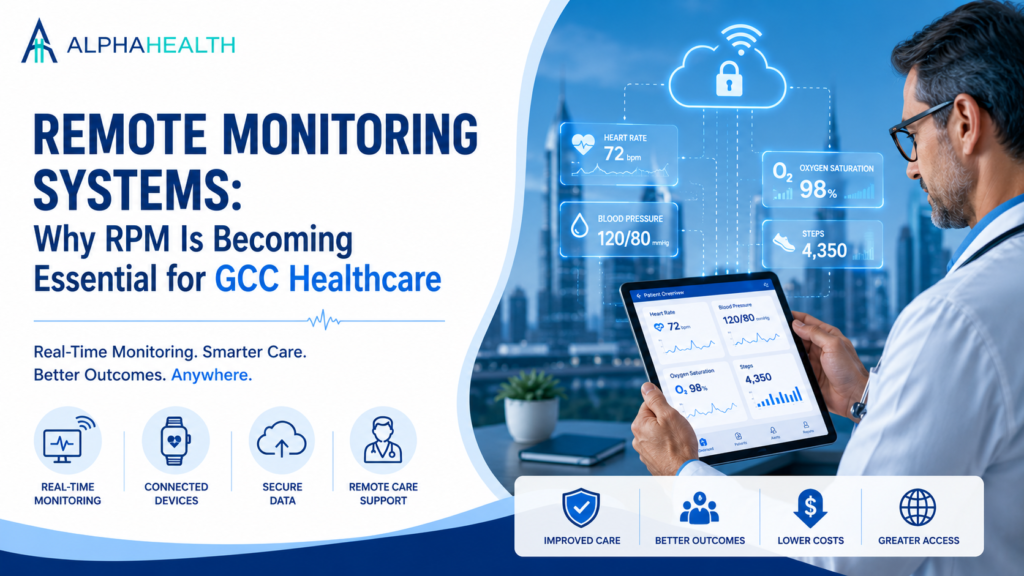
Healthcare systems across the GCC are evolving rapidly. With increasing patient populations, rising chronic disease cases, expanding smart healthcare initiatives, and growing pressure on hospitals, healthcare providers are now looking for more efficient ways to deliver continuous care.
One of the most impactful innovations driving this transformation is the Remote Patient Monitoring (RPM) system.
Remote Patient Monitoring allows healthcare providers to track patient health data in real time using connected medical devices, wearable technology, and digital health platforms. Instead of relying only on hospital visits, physicians and care teams can monitor patients remotely, detect early warning signs, and respond faster to health risks.
For GCC healthcare systems, RPM is no longer just a technological upgrade — it is becoming a critical healthcare strategy.
The Growing Healthcare Challenges in the GCC
Countries across the GCC, including the UAE, Saudi Arabia, Qatar, and Kuwait, are facing several healthcare challenges simultaneously:
- Rising rates of diabetes, hypertension, obesity, and cardiovascular diseases
- Increasing elderly population requiring long-term care
- High demand for healthcare accessibility in remote areas
- Pressure on hospitals and emergency departments
- Need for cost-efficient healthcare delivery
- Government focus on digital healthcare transformation
Traditional healthcare models alone are no longer sufficient to manage these challenges effectively.
This is where RPM creates a major advantage.
What Is Remote Patient Monitoring?
Remote Patient Monitoring is a healthcare technology system that collects patient health data outside traditional clinical environments.
Using connected devices such as:
- Vital sign monitors
- ECG monitors
- Pulse oximeters
- Blood pressure devices
- Glucose monitoring systems
- Wearable health trackers
Healthcare providers can continuously monitor patient conditions remotely through secure digital platforms.
The collected data is automatically transmitted to healthcare teams for real-time review and analysis.
This enables early intervention before a condition becomes critical.
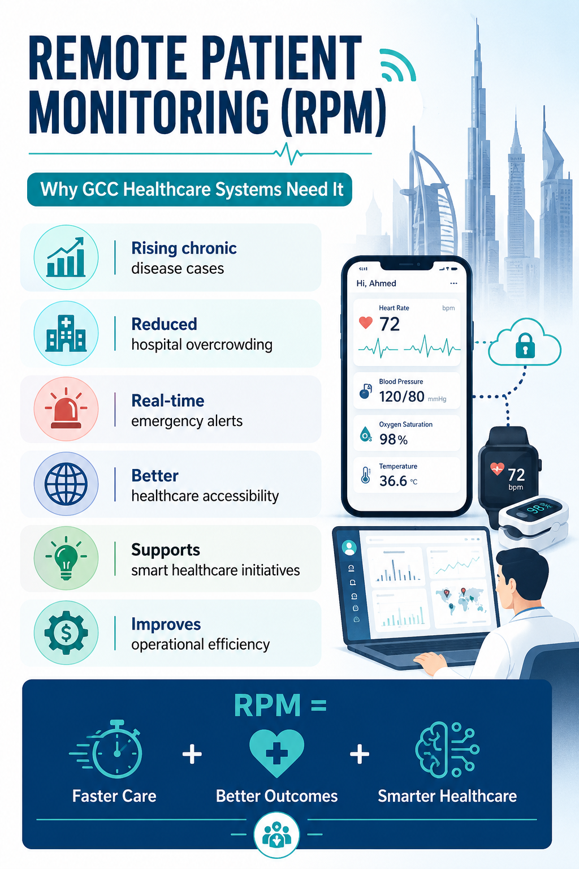
Why RPM Is Critical for GCC Healthcare Systems
1. Managing Chronic Diseases More Effectively
The GCC region has one of the highest rates of chronic diseases globally, especially diabetes and hypertension.
RPM allows continuous tracking of patient vitals and health patterns, helping physicians:
- Identify abnormalities early
- Reduce complications
- Improve medication adherence
- Prevent avoidable hospital admissions
Instead of reactive healthcare, RPM enables proactive care management.
2. Reducing Hospital Burden
Hospitals across the GCC are under increasing operational pressure.
RPM helps reduce:
- Unnecessary emergency visits
- Repeat hospital admissions
- Length of patient stays
- Overcrowding in healthcare facilities
Patients with stable conditions can recover safely at home while still being monitored by healthcare professionals.
This improves hospital efficiency and optimizes resource utilization.
3. Supporting Smart Healthcare Initiatives
Governments across the GCC are heavily investing in:
- Smart hospitals
- Digital health infrastructure
- AI-driven healthcare
- Telemedicine systems
- Connected healthcare ecosystems
RPM fits directly into these national healthcare transformation goals.
It enables healthcare systems to become:
- More data-driven
- More preventive
- More patient-centric
- More digitally connected
4. Improving Healthcare Accessibility
Certain areas across the GCC still face healthcare accessibility challenges, especially rural and remote regions.
RPM bridges this gap by enabling healthcare providers to monitor patients without requiring frequent hospital visits.
Patients can receive continuous care from their homes while doctors maintain visibility into their health conditions.
This is particularly important for:
- Elderly patients
- Post-surgery recovery patients
- High-risk patients
- Patients with mobility limitations
5. Faster Emergency Detection
One of the biggest advantages of RPM is real-time alerts.
Modern monitoring systems can immediately notify healthcare teams if a patient experiences:
- Oxygen level drops
- Irregular heart rhythms
- Sudden blood pressure changes
- Signs of deterioration
This allows faster medical intervention before a condition becomes life-threatening.
In critical care environments, early detection can significantly improve patient outcomes.
6. Cost Optimization for Healthcare Providers
RPM helps healthcare organizations reduce operational costs while improving care quality.
Benefits include:
- Lower hospitalization costs
- Reduced ICU burden
- Fewer readmissions
- Better staff efficiency
- Improved workflow automation
For healthcare systems aiming to scale sustainably, RPM offers long-term financial advantages.
The Future of Healthcare in the GCC
The future of healthcare is moving beyond hospital walls.
Patients now expect:
- Convenience
- Faster care
- Personalized monitoring
- Digital healthcare experiences
Healthcare providers need solutions that combine:
- Real-time monitoring
- AI-powered analytics
- Remote accessibility
- Predictive healthcare intelligence
RPM systems are becoming the foundation of this next-generation healthcare model.
As GCC healthcare systems continue to modernize, Remote Patient Monitoring will play a central role in improving patient outcomes, operational efficiency, and healthcare accessibility.
Conclusion
Remote Patient Monitoring is transforming the way healthcare is delivered across the GCC.
By enabling continuous patient monitoring, reducing hospital burden, supporting smart healthcare initiatives, and improving early detection, RPM is helping healthcare systems become more proactive, connected, and efficient.
For healthcare providers across the GCC, investing in RPM is not just about adopting new technology — it is about building a smarter and more sustainable future for patient care.